 English
  Cymraeg
Whitchurch History Cymru
The Philog Experience

Our second, and quite long, walk was along the Philog starting from opposite the Three Elms all the way to Manor Way. The start of the walk is now marked by our permanent map board designed by local artist Anthony Evans.

Walk waymarkers

Ararat Church
Probably the oldest surviving chapel in the village. Originally built by local Baptists in 1824 and rebuilt and extended many times over the years.
The sketch shows the chapel in 1851, but is almost unrecognisable from today’s chapel.
The churchyard contains the graves of many of the local families at this end of the village.

Holly Cottages
It has been suggested that Holly Cottages are the oldest houses still standing in the lower village. The pair of houses we see today with slated roofs and modern windows would have been very different. Perhaps a thatched roof, limewashed walls and tiny sash windows, maybe even as three tiny cottages.
Phillip Williams was 40 years old in 1851, and was living in Holly Cottages with his wife and young family. His father (also Phillip) aged 70 was living there too. Phillip had a brother William who again was living in the cottage with his son, also called William (all very confusing).
The Williams family lived in Holly Cottages for the next 70 years.

Bryn Glas
William Vachell was a retired ‘druggist’ in 1851 when he built Bryn Glas as his retirement home.
It’s all gone now, but it must have been a splendid mansion for a 62-year-old widower. He had a housekeeper and 2 servants to look after him, and the gardens were huge and landscaped, stretching all the way down to the Philog.
By 1861, William had died, and engineer William Bedlington and his family were living there instead. The family were still there in 1891.
After WW1, the house had become derelict and finally demolished. Retford Court flats now occupy the site of Bryn Glas.

Old Povey's house
John Povey was 69 years-old when he moved to Whitchurch in 1861. The cottage was generous and the garden huge. Just right for a market gardener and his extended family from Berkshire.
He must have been something of a character, as the house, sitting at the top of the hill at Gwauntreoda became known to all as ‘Old Povey’s House’ and was still called that in 1904.
It’s not known when the cottage was demolished, but the Philog Court flats with its well-known pierced concrete screen was one of the earliest blocks of flats to be built in the village.

Baylis' shop
Samuel Baylis was a market gardener and was born in Wilshire. He moved to Gwauntreoda in the 1870s with his family and a young wife (he’d become widowed just previously). Sam’s eldest son William was also a market gardener, and he too had a family.
Two of William’s boys joined their father in the business, probably working on the fields behind the main road.
For a while though, William’s eldest son William Henry lodged at the Wauntreoda shop just a few houses away, and worked as a baker.
In due course, Sam died and his widow Elizabeth and the rest of the family continued as market gardeners, and lived next door to William Henry. The shop eventually became Baylis’, run by Alf Baylis in the 1930s; well known as the greengrocers for the lower village.

The Philog
We’re told that in 1811, the name Philog referred ‘particularly to an old thatched house on the north side of the highroad to Whitchurch, where a lane branches off eastwards to the Heath’.
The row of tiny cottages sat on the narrow road where Eddy’s bakery once was. Y Filog is mentioned in the earliest census returns, but any detail has been long lost.
The sketch, based on an old photograph, might well be Y Filog.

Philog House
There has been a house on this corner for at least 200 years. Maybe much longer.
The name Philog is lost in history, with many strange suggestions. There was a detached house on the plot at the time of the Tithe Map, with various outbuildings.
Philog House appears on early census forms and has had numerous tenants and owners over the years.
One tenant, Henry Hopkins had moved into Philog House by 1881. He was the Relieving Officer for the district. It was his job to ‘dole’ out the poor relief to the poorest in the parish.
Many locals still refer to the house as ‘Hopkins Corner’, and it’s been suggested that there are still indications of a blocked-up window in the house where the poor would seek parish assistance.

Sam Bennett, Builder
Sam Bennett, a Cornishman, was a builder who constructed many of the houses in the village. After his death, his sons continued the business, building many of the houses at the bottom end of Manor Way (now the A470).
The sons built the large house on the corner for their mother to live in, who named it Manor House!
The boys also built the strangely-shaped building facing The Philog, as a hairdressing salon for their sister, with a small flat over. It’s now converted into a small house.

Plwca Halog
The Philog Brook defines the historic boundary between the Parish and the town of Cardiff. It’s now been culverted under the road
In the dim and distant past, the area was a wild and open area, with just a rough track running between the village and its larger neighbour
We’re told that a lost name in the Whitchurch area from 1605 was Plwca Halog, which means the ‘Foul or Defiled Pleck’. So, was this area Plwca Halog? Perhaps the place where the village stocks were located? Or maybe the location for the gibbet?
Just to warn strangers!

War Damage
January 1941 was a bad time for bombing in Cardiff. Here are some village stories:
“We were having supper at the table in the living room of our house in Violet Place when the air raid siren sounded. Next thing we heard was a terrific bang and all went black. I remember my neighbour Tom shouting, asking if we were all right. We were covered in rubble and all of the back of the house was completely down”
“Another bomb fell on the corner of Wauntreoda Road, completely destroying it. My dad was an air raid warden and was blown into Eddy’s baker shop opposite”
“We were taken to Ararat Church for the night, and the next day to Coryton Lodge until we were able to find ‘rooms’ as people did in wartime”

Flays Farm
Flays Farm is long gone and replaced by the houses we see today. The detached building is probably all that remains
Originally called Gwauntreoda Farm, its origins are unknown. It was there in 1841, but was probably much older
The Flay family lived here in the early 20th century, and farmed all of the land to the south. They used shire horses for ploughing and to pull the wagons at harvest time
They were awarded the contract to collect all of the rubbish from the village houses and they used the same shire horses and carts. They were a well-known sight in the village at the time. The rubbish was dumped into the quarry at Maindy (now Maindy Stadium and Swimming Pool)
Whitchurch Common
Whitchurch Common was never common land, but formed part of 4 mediaeval manors meeting here. It was gifted to the parish council in the early part of the 20th century
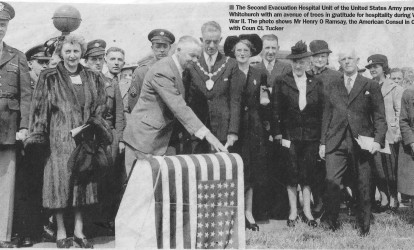
Once the site of Gypsy camps and irregular fairs, the high point of the common arose in 1943, when a unit of the American Army encamped here for months whilst training for D-Day. Many older residents still fondly remember this period
The avenues of trees lining the road were purchased by a gift of money from the Americans in appreciation of the warmth given by the village to the soldiers. The plaques commemorate this

Vine Cottage
Vine Cottage no longer exists. It was another modest thatched cottage, this one located alongside the Whitchurch Brook on the site of the builder’s merchant’s yard
The sketch shows how Vine Cottage might have looked in 1892 with whitewashed walls and tiny windows
Vine Cottage was home to Eli Evans, who was listed in the 1841 census as a sculptor. It seems that Eli was more of a monumental mason however, and he designed many of the gravestones and memorials around the village, including the family mausoleum for the Bookers in old St Mary’s graveyard
He’s buried in Ararat Chapel opposite, but sadly without a gravestone

Three Elms pub
The Three Elms Pub has been on Whitchurch Common since the 18th century
On the Tithe Map of 1841 the Three Elms Pub was an old building set at an angle to the road, so that it formed an informal square. The sketch shows what the old pub probably looked like in 1892
The local blacksmith had his forge alongside the pub and the brook
In the mid-19th century, the square was home, twice-a-year to a very popular horticultural show sponsored by Thomas Booker, the local ironmaster. It’s not surprising that many of the show prizes awarded were won by Mr Booker’s own gardener